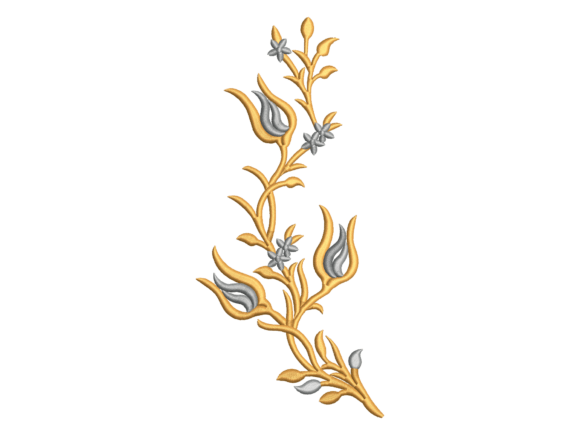
Ottoman Tulip Branch Embroidery
As a designer who’s stitched hundreds of floral motifs—from delicate daisies to bold peonies—I opened the Ottoman Tulip Branch Embroidery file with quiet curiosity. Not hype, not urgency—just the practiced pause before testing whether a design will hold up in real life: on a linen tea towel for a boutique launch, across the chest of a baby onesie, or as a signature motif on a small-batch embroidered tote bag.
A First Impression That Feels Intentional
This isn’t just another tulip. The Ottoman Tulip Branch Embroidery carries weight and rhythm—a graceful, slightly asymmetrical branch with three blooms at varying stages: one tight bud, one mid-bloom with layered petals, and one fully open, facing outward like it’s catching light. There’s Ottoman-era influence in the subtle curvature of the stems and the restrained elegance of the leaf forms—not fussy, not stiff, but deeply considered. It reads as timeless rather than trendy, making it ideal for handmade products meant to age well: nursery decor, heirloom-style kitchen towels, or wedding guest gifts stitched onto organic cotton napkins.
Where It Shines in Real Projects
I tested the Ottoman Tulip Branch Embroidery on three very different items: a heavyweight cotton tote, a medium-weight French terry sweatshirt, and a soft bamboo-cotton baby blanket. On the tote, it held crisp definition—especially the satin-stitched petal edges—without overwhelming the fabric. On the sweatshirt, the branch flowed naturally across the chest curve; the stitch density was balanced enough to avoid puckering, yet dense enough to read clearly from three feet away. And on the baby blanket? It landed with gentle authority—soft enough for skin contact, distinct enough to feel intentional, not generic.
It works especially well for custom apparel where subtlety matters—think monogrammed lounge sets or minimalist aprons for artisan bakers. As a personalized gift, it adds quiet sophistication without shouting. For Etsy sellers and small shop owners, it’s a strong candidate for a signature motif: pair it with neutral thread colors (oatmeal, slate, deep olive) and let the shape do the talking. It also translates beautifully into a standalone embroidered patch—clean lines, clear negative space, and no tiny interior details that vanish at 2 inches wide.
Where to Proceed With Care
The Ottoman Tulip Branch Embroidery is not built for micro-hoops or ultra-fine fabrics. I wouldn’t recommend it for a child’s knit beanie—too much stem detail risks distortion on stretchy, curved surfaces. Likewise, avoid placing it directly over seams or thick fabric layers (like quilted jackets) unless you’ve tested stabilizer support thoroughly. On dark fabric, check that the fill stitch density provides enough coverage—some floral designs fade visually if the underlay is too sparse. And while the leaves have lovely taper, the tips are fine enough that they may blur slightly on loosely woven linens or highly textured toweling unless paired with cutaway stabilizer.
Also worth noting: this is a machine embroidery design, not an applique design. There’s no raw-edge fabric layering here—it relies entirely on stitch execution. So if your workflow leans heavily on fusible applique, this won’t slot in seamlessly without adaptation.
What It Adds—Beyond Just Stitches
Using the Ottoman Tulip Branch Embroidery elevates perceived value without demanding premium pricing. Customers notice the balance—the way the branch bends *just so*, how the blooms don’t mirror each other, how the negative space between stems invites the fabric to breathe. That kind of nuance builds customer trust: it signals care, not automation. For craft business owners, that’s gold. It strengthens brand consistency when used across product lines (e.g., matching pillow covers and tea towels), and boosts buyer engagement because it feels distinctive—not mass-digital, but hand-selected and thoughtfully placed.
It also performs well in printable mockups. Because the composition has strong directional flow and clear visual hierarchy, it scales cleanly for digital previews—no pixelated edges, no lost detail in thumbnail size. That’s a quiet win for Etsy sellers building listings or creative entrepreneurs pitching to local boutiques.
Practical Designer Notes Before You Stitch
- Always test first—run the Ottoman Tulip Branch Embroidery on scrap fabric matching your final project’s weight and weave.
- Check thread color contrast on both light and dark backgrounds. Some floral designs lose legibility in low-contrast combos—this one holds up well, but verify.
- Review stitch density in your embroidery software. If you’re stitching on lightweight cotton or knits, consider reducing density by 5–10% to prevent stiffness.
- Confirm hoop size compatibility. While the design fits comfortably in a 5x7 hoop, double-check your machine’s max dimensions—especially if adapting for caps or curved garments.
- Inspect small details manually: leaf tips, petal edges, stem taper. Zoom in on the .dst or .pes file—look for stray jump stitches or underlay gaps.
- Test black-and-white mockups to assess silhouette strength. A great floral embroidery file should read clearly even without color.
- Use appropriate stabilizer: medium tear-away for stable wovens, cutaway for knits or delicate fabrics.
- Verify licensing before selling finished items or bundling the digital embroidery file with your own products. This is a digital embroidery file delivered in ZIP or RAR format—no physical item shipped, no returns or refunds.
The Ottoman Tulip Branch Embroidery doesn’t try to be everything. It’s not oversized for festival merch, nor hyper-minimal for techwear. It’s a focused, fluent piece of floral embroidery—designed for makers who value intention over impulse, clarity over clutter, and quiet beauty over loud novelty. Whether you’re stitching a single personalized gift or building a cohesive line of small shop products, it earns its place—not as filler, but as foundation.